
Print Culture, Before the Internet
Before Photobooks: Japan’s Shrink-Wrapped Magazine Era
A strange little chapter of retail history where the whole point was that you couldn’t look inside before you bought it.
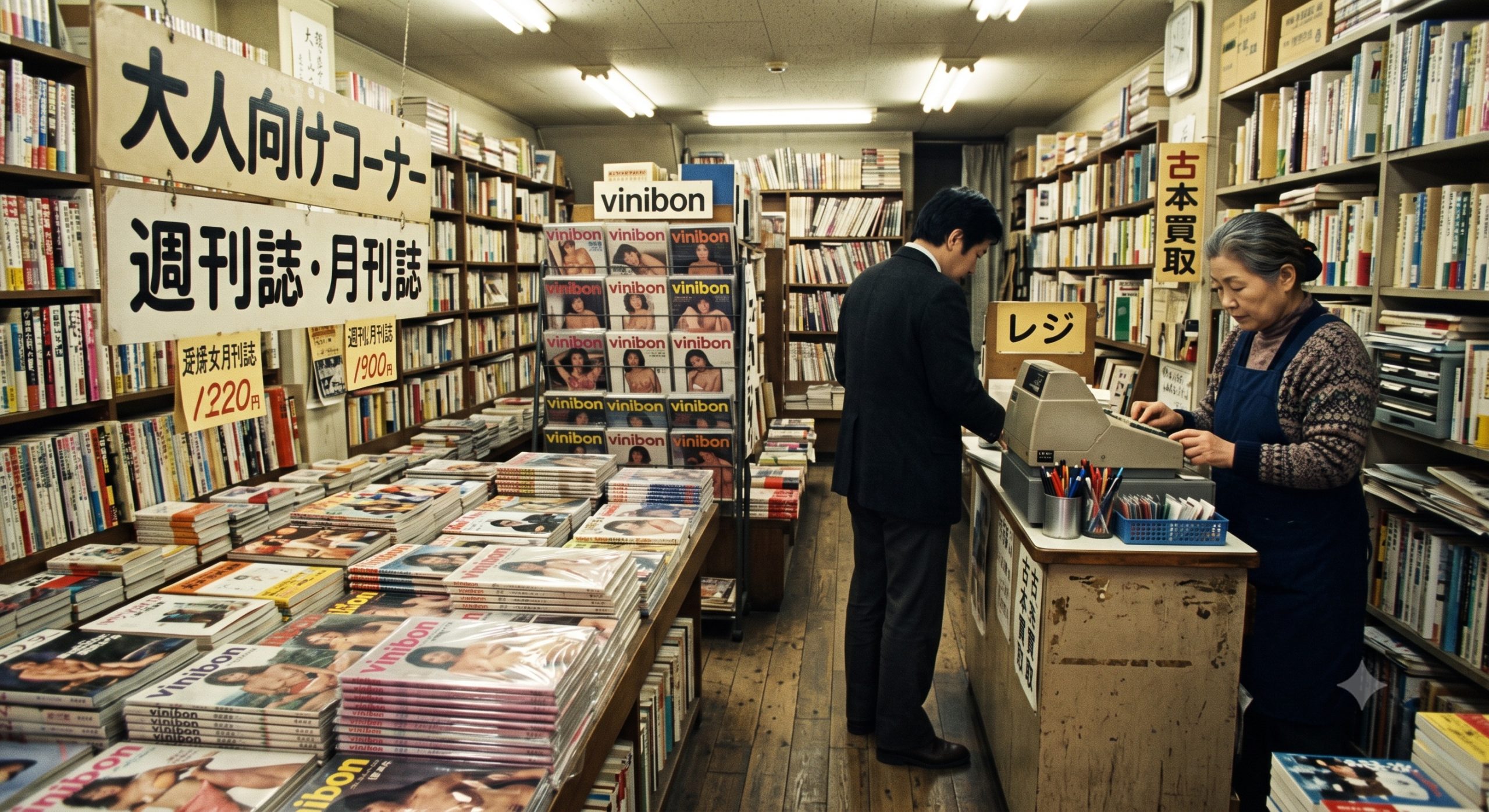
Somebody who grew up browsing bookstores in Japan during the late 70s or 80s will probably remember this without needing much explanation. A certain shelf, usually tucked toward the back, lined with magazines wrapped tight in plastic film. No preview page. No table of contents you could flip through. Just a cover, a price tag, and a decision you had to make blind.
They called them binibon — literally, vinyl books. And for about a decade and a half they were one of the stranger fixtures of Japanese adult publishing, right before the photobook as we know it today started taking shape.
Why Wrap a Magazine in Plastic
The short answer is regulation, or something adjacent to it. Bookstores in Japan operated under a loose but real set of self-imposed standards about what could be displayed openly, and adult content sat in a gray zone that publishers had to navigate carefully. Shrink-wrapping was, in part, a compliance move — you couldn’t be accused of displaying explicit material if nobody could actually see it without paying first.
But it wasn’t purely defensive. Publishers noticed something interesting happened once you sealed a magazine shut. People wanted it more. There’s a particular kind of curiosity that gets switched on the moment something is deliberately hidden from you, and binibon leaned into that almost by accident.
Buying Blind Was Basically the Whole Experience
You’d be standing there with maybe three or four titles to choose from, judging entirely by the cover shot and whatever cropped image made it past the wrap. No back-cover preview, no browsing the middle pages the way you might with a regular magazine. Just the cover, a title, sometimes a name printed in bold.
Some stores got creative with this. A few would leave one unwrapped “sample copy” chained to a display rack so customers could at least get a sense of print quality and page count before committing to a sealed one. Whether that actually helped anyone make a better decision is debatable — by the time you’d flipped through the sample, you’d usually already decided based on the cover anyway.
It Wasn’t Really About Photography
Worth saying clearly — binibon weren’t particularly known for photographic quality. A lot of them were shot cheaply, printed on thin paper, and produced fast to keep up with turnover. The appeal was somewhere else entirely. Part novelty, part the thrill of not knowing, and honestly part just being one of the only widely available formats at the time.
Home video was still expensive and rare through most of the binibon years. The internet obviously didn’t exist yet in any consumer sense. If you wanted adult content in printed form, and you wanted it from an actual store rather than something passed hand to hand, this was more or less it.
The Slow Fade
Binibon didn’t really get killed off by a single law or a single scandal. It faded the way a lot of retail formats fade — gradually, as something better came along. Video rental shops started spreading through the 80s. Print quality on regular gravure magazines improved. And eventually the photobook format itself matured into something with actual production value, actual named talent on the cover, actual marketing behind it.
Once photobooks became a legitimate, well-produced category with recognizable idols attached, the whole shrink-wrapped mystery-box approach started looking a little cheap by comparison. Why buy blind when you could buy a proper book with a known face on the cover.
By the early 90s binibon had mostly disappeared from mainstream shelves. A handful of specialty and secondhand stores still carry them as a kind of retro curiosity, more collector’s item than anything anyone’s actually reading for content at this point.
What It Left Behind
There’s an argument that binibon quietly set up some of the packaging instincts that later adult media in Japan still carries. The idea that presentation and mystery matter almost as much as content. The comfort with a certain level of self-regulation that keeps things technically compliant while still meeting demand. Even the modern habit of censoring visuals rather than removing them outright kind of rhymes with the binibon logic — cover it, don’t erase it.
It’s a small, mostly forgotten format now. But it sat right at the hinge point between the magazine era and the photobook era, and it’s a decent reminder that Japan’s adult media history has always been shaped as much by retail logistics and self-censorship workarounds as by the content itself.
Japanese Note: 日本語補足
ビニ本とは、1970年代後半から80年代にかけて流通した、ビニールで密封された成人向け雑誌のことです。中身を確認できないまま購入する形式そのものが特徴で、書店側の自主規制とも深く関係していました。
写真としてのクオリティが高かったわけではなく、当時まだビデオもインターネットも一般的でなかった時代における、数少ない選択肢の一つだったという側面が大きいです。80年代を通してビデオレンタルの普及や写真集フォーマットの成熟とともに徐々に姿を消し、90年代初頭にはほぼ店頭から消えました。
今ではごく一部の専門店や古書店で見かける程度の、レトロな収集対象になっています。